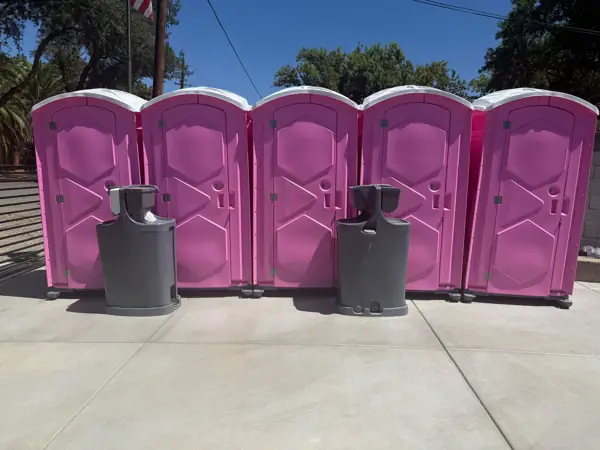
What does OSHA require for toilets on a Texas construction site?
OSHA rule 29 CFR 1926.51(c), Table D-1, sets the minimum toilets on a construction site. Crews of 20 or fewer need 1 toilet. Crews of 20 or more need 1 toilet seat and 1 urinal per 40 workers. Crews of 200 or more need 1 seat and 1 urinal per 50 workers.
| Number of workers | Minimum facilities | Standard units that meet it |
|---|---|---|
| 20 or fewer | 1 toilet | 1 |
| 20 or more | 1 toilet seat and 1 urinal per 40 workers | 1 per 40 workers |
| 200 or more | 1 toilet seat and 1 urinal per 50 workers | 1 per 50 workers |
A standard porta potty has both a toilet seat and a urinal, so one unit counts as one "seat and urinal." Read the rule text at OSHA 1926.51, Sanitation.
Does Texas have its own job site toilet rule?
Texas does not run its own OSHA state plan for private employers, so federal OSHA rules cover most Texas construction sites. That means 29 CFR 1926.51 is the toilet rule for private job sites in Pasadena, Houston and the rest of the state. Local codes can still limit which toilet types are allowed.
You can confirm which states run their own plans on OSHA's State Plans page. Public-sector job sites and city contracts may add their own rules. Ask the project owner or general contractor.
What counts as a toilet under the OSHA rule?
OSHA 1926.51(c)(3) lists four toilet types for job sites without a sanitary sewer: privies, chemical toilets, recirculating toilets and combustion toilets, unless local codes prohibit them. A standard porta potty is a chemical toilet. Each one has a deodorizing chemical in a tank of about 60 gallons.
Our standard unit is about 92 x 44 x 47 inches, with a toilet seat, urinal, vent stack and hand sanitizer dispenser. Exact models are confirmed on your quote. See our construction site toilet rentals for unit options.
Are mobile crews exempt from the OSHA toilet rule?
Mobile crews are exempt from the 1926.51(c) toilet table when they have transportation readily available to nearby toilet facilities. A utility crew moving between stops with a truck may qualify. A framing crew working at one house for weeks does not, and needs a unit on site.
"Readily available" is the key phrase. If workers would wait or lose work time to find a restroom, plan a unit on site. When in doubt, a single standard unit settles the question.
Do construction sites need hand washing stations?
OSHA 1926.51(f) requires adequate washing facilities when workers apply paints, coatings, herbicides or insecticides, or work with other harmful contaminants. Those facilities need running water, hand soap and towels. Many general sites add a 2-sink hand washing station anyway, which holds about 34 gallons of fresh water.
Ask your safety lead whether a portable station meets your job's needs. Painting, demolition and plant turnaround crews often pair each cluster of units with a hand washing station.
How many porta potties do we recommend per worker?
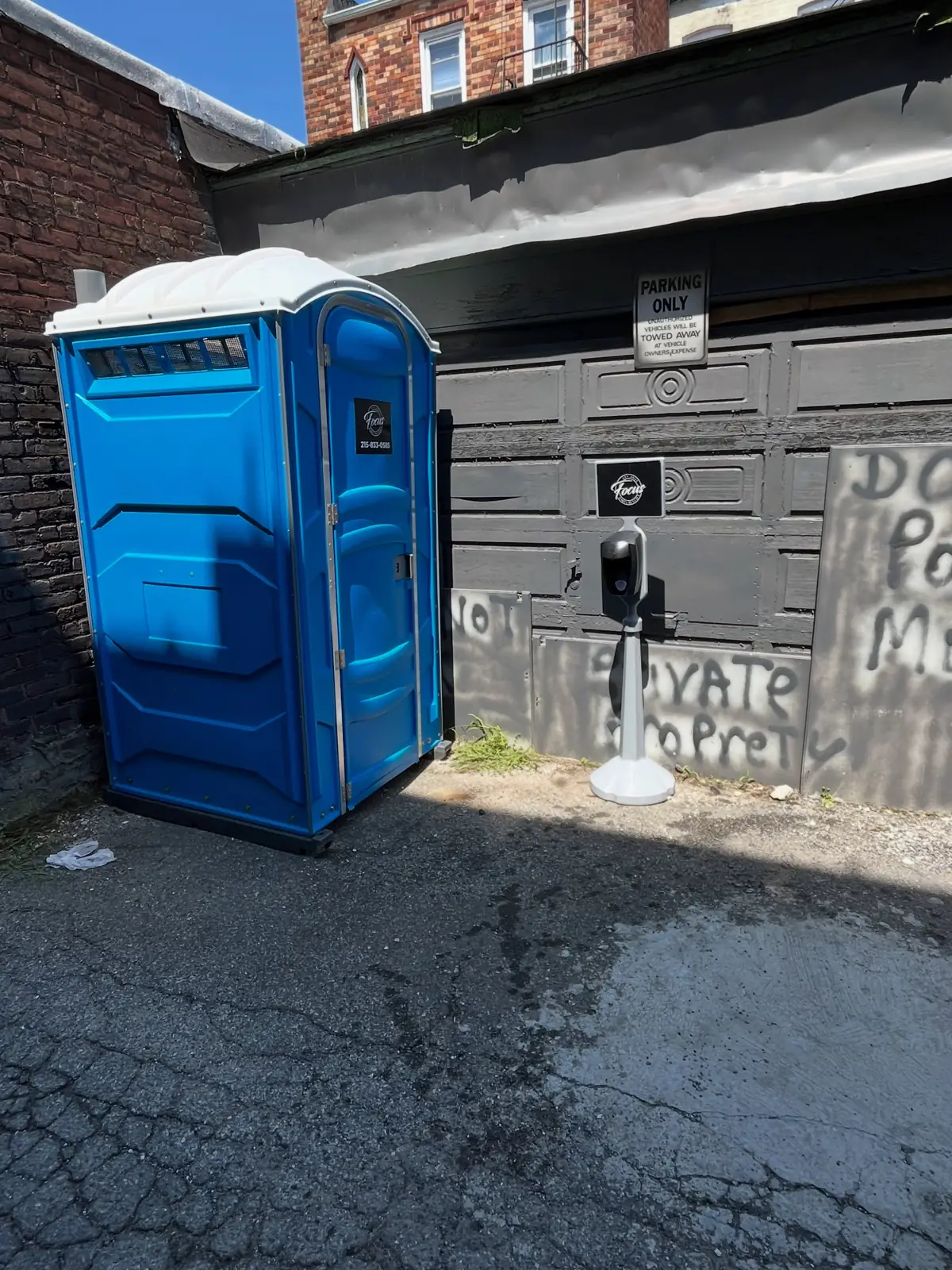
We recommend 1 standard porta potty per 10 workers on a 40-hour week with weekly service. A unit is rated for about 200 uses between services. Ten workers using it 4 times a day for 5 days reach about 200 uses. At OSHA's 1 per 40, the tank fills in under 2 days.
| Crew | OSHA minimum | Our recommendation | Uses per unit per week* |
|---|---|---|---|
| 10 | 1 toilet | 1 unit | ~200 |
| 25 | 1 seat + 1 urinal | 3 units | ~167 |
| 40 | 1 seat + 1 urinal | 4 units | ~200 |
| 80 | 2 seats + 2 urinals | 8 units | ~200 |
*Assumes 4 uses per worker per day, 5 days a week. Larger crews can use fewer units with twice-weekly service. Run your crew size through our porta potty calculator.
How often should job site toilets be serviced?
Job site toilets should be serviced at least once a week, and rentals of 7 days or longer include weekly service with us. At each job site visit we pump the waste tank, sanitize the seat, walls and floor, refill paper and sanitizer, and add fresh chemical. Big crews and summer heat often need 2 visits a week.
Waste goes only to authorized disposal sites. In Texas, haulers must be registered sludge transporters with the TCEQ under 30 TAC Chapter 312. You can read about that program on the TCEQ sludge transporter page.
What does a construction porta potty cost?
A standard construction porta potty starts at about $199 per 28-day cycle with weekly service. The first cycle adds a one-time delivery and pickup charge of about $49–$99, by distance. Both numbers are estimates before the 8.25% Texas sales tax.
A 25-person crew on our recommended 3 units for one cycle starts at about $597 plus one delivery charge. Billing renews every 28 days until you call for pickup, and stops the day you call. Full details are on our long-term rental page.
Where should units go on a job site?
Job site units should go on firm, level ground within about 15 feet of where a service truck can park. Keep a 10-foot-wide lane open for the truck, with no low power lines or limbs over it. On public-facing or overnight sites, a lock hasp helps prevent vandalism, which renters are responsible for.
- Keep units off the path of cranes, forklifts and dump trucks.
- Do not block fire lanes or hydrants.
- Stake or strap units in open, windy lots.
- Move units as the build moves, with a call to dispatch.